
Acronis has positioned itself as a leader in what it calls "Cyber Protection," combining backup, disaster recovery, and endpoint security into a single platform. With over 750,000 business customers worldwide and recognition as a leading cybersecurity provider, it has become a popular choice for Managed Service Providers (MSPs) looking to consolidate their security and backup tools into one solution.
To create this Acronis review, I've analyzed the platform extensively. I believe it's the ideal choice if:
- You want a single agent handling backup, antivirus, and endpoint protection
- You prioritize ransomware defense with automatic file restoration
- You need disaster recovery with rapid cloud failover
- You prefer managing all cyber protection from one console
- Your security focus is primarily on the endpoint
However, Acronis might not be the best choice if:
- You find Acronis's multi-module Advanced Pack structure adds complexity and unpredictable costs
- You want purpose-built, natively developed email security rather than third-party powered add-ons
- You need behavior-driven security training with real-time intervention
- You're an MSP seeking a dedicated Account Manager and simplified vendor relationship
- Near-instant streaming data recovery is critical for your operations
In this case, you should consider CyberSentriq: a unified cybersecurity and data protection platform formed from the merger of TitanHQ (with nearly 30 years of email security expertise) and Redstor (cloud-native backup innovator). Rather than fragmenting capabilities across separately purchased modules, CyberSentriq delivers an integrated MSP-first platform combining purpose-built email security, web filtering, security awareness training, and cloud-native backup with InstantData™ streaming recovery.
I've included a detailed look at CyberSentriq later in this Acronis review. If you're interested in exploring a streamlined approach to cyber protection, you can learn more about CyberSentriq here.
What is Acronis?
Acronis is a Swiss global technology company founded in 2003 by Serguei Beloussov, Stanislav Protassov, and Ilya Zubarev.
The company began as a spin-off from SWsoft (later Parallels), initially focusing on disk imaging and backup software. Their first major product, Acronis True Image, became a widely adopted solution for disk cloning and bare-metal recovery.
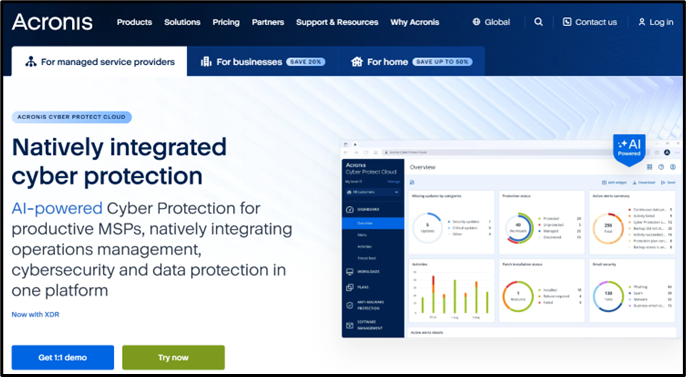
Over time, Acronis recognized that backup alone was insufficient against modern threats like ransomware. This led to their pivot toward "Cyber Protection" in 2018, a term they use to describe their approach of merging data protection with cybersecurity.
Their flagship offering, Acronis Cyber Protect Cloud, is designed primarily for MSPs to deliver backup, disaster recovery, cybersecurity, and endpoint management from a single console.
The platform serves over 750,000 business customers and has been valued at over $3.5 billion. In August 2024, Swedish private equity firm EQT acquired a majority stake in the company. Acronis employs approximately 1,700 to 2,000 people globally, with headquarters in Schaffhausen, Switzerland.
Acronis's ideal customers include MSPs managing IT for SMB clients, businesses with limited IT staff who need a "set it and forget it" solution, and organizations that want to reduce vendor sprawl by consolidating backup and security tools.
Acronis Pros & Cons
|
Pros |
Cons |
|
✅ Single agent for backup and endpoint security |
❌ Agent can be resource-heavy, impacting system performance |
|
✅ Strong ransomware defense with Active Protection |
❌ Dashboard and policy engine can be overcomplicated |
|
✅ Comprehensive backup with Universal Restore |
❌ Advanced Pack modules create fragmented, à la carte pricing |
|
✅ Large global data center network |
❌ Email security and SAT powered by third-party technology |
|
✅ Native integrations with major PSA/RMM tools |
❌ URL filtering limited compared to dedicated DNS solutions |
|
✅ Forensic backup captures volatile data |
❌ Significant training overhead for MSPs managing large portfolios |
Acronis Review: How it Works & Key Features
Backup and Recovery
Acronis's backup engine is a core component of its cyber protection platform.
The system supports full image backups that capture entire drives, including the operating system, applications, and data. This sector-level approach uses Changed Block Tracking (CBT) for subsequent backups, meaning only modified blocks are transferred after the initial full backup.
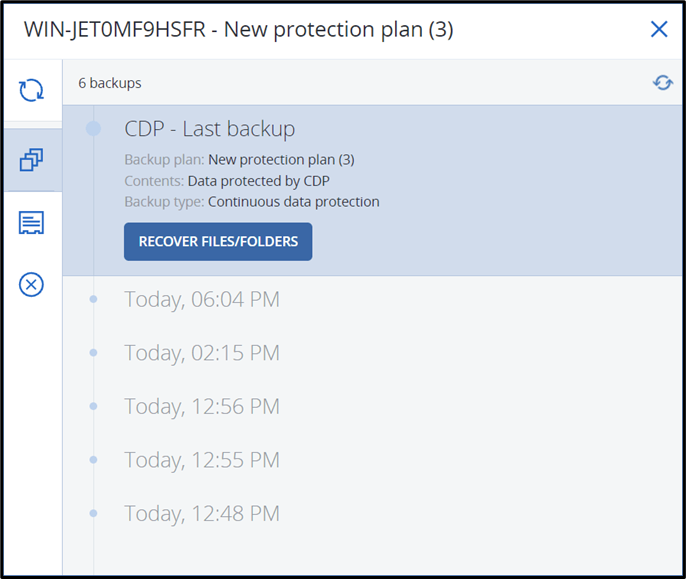
For critical data, Continuous Data Protection (CDP) monitors specific applications or folders and captures changes in real-time. Every time a user saves a document, Acronis immediately copies that change to the backup destination, eliminating data loss between scheduled backups.
Source: Acronis
Universal Restore solves hardware compatibility issues during recovery. When restoring a system image to different hardware, the technology injects the necessary drivers into the restored OS before it boots. This allows migration from a Dell server to HP hardware, or from physical to virtual environments, without boot failures.
Instant Restore takes recovery speed further.
Instead of copying data back to a physical disk, Acronis mounts the backup file directly as a virtual disk datastore and commands the hypervisor to boot a new VM using that backup. A failed server can be running as a VM in seconds, though actual performance varies by environment and infrastructure.
Forensic Backup captures volatile data for incident investigation, including RAM dumps, running processes, and unallocated disk space. The backup is automatically notarized via blockchain to ensure evidence is admissible and has not been tampered with.
Acronis Active Protection
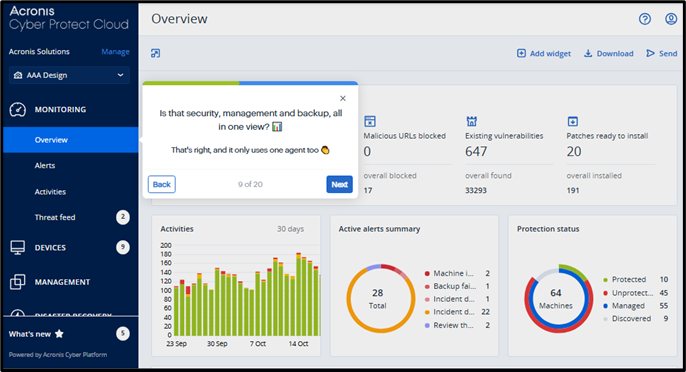
Active Protection is Acronis's AI-powered anti-ransomware technology. Rather than relying solely on signature-based detection, it monitors system processes in real-time using behavioral heuristics.
The system watches for suspicious patterns like rapid file renaming, mass encryption, or code injection into trusted processes. When malicious behavior is detected, Active Protection blocks the process and can automatically restore affected files from a local cache when configured to do so.
Source: Acronis
A self-defense module protects the Acronis agent itself. It prevents unauthorized processes from terminating Acronis services, modifying backup files, or altering configuration settings. While this protection is robust, administrators with sufficient privileges can disable these protections if needed.
Active Protection also detects cryptomining malware by monitoring process behavior consistent with mining activity. Upon detection, it alerts the user and terminates the mining process to reclaim system resources.
Disaster Recovery
Acronis Cyber Disaster Recovery operates as a Disaster Recovery as a Service (DRaaS) solution built on top of the backup platform. It turns standard backups into running virtual machines in the Acronis Cloud when local infrastructure fails.
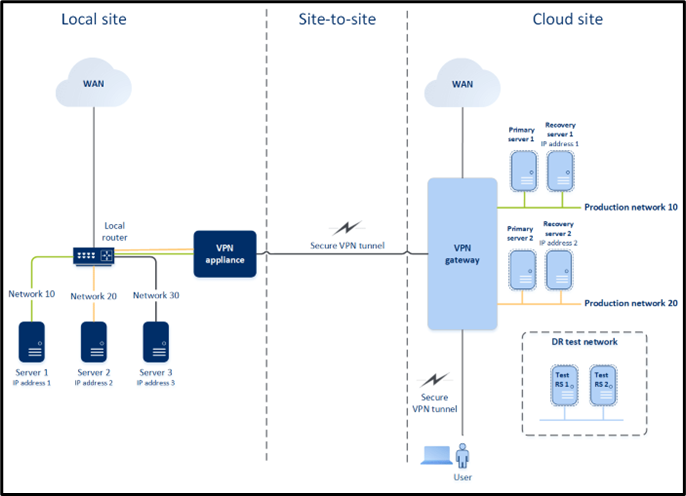
Cloud Failover supports Recovery Time Objectives (RTO) of typically less than 15 minutes. When failover is initiated, users select a recovery point, and the Acronis Cloud mounts the backup and boots a Recovery Server. A VPN Gateway connects the cloud network to the local office network, ensuring the cloud server appears on the local LAN.
Source: Acronis
Runbooks handle complex environments with multiple servers. Administrators can define the boot order (Domain Controller first, then SQL Database, then Web Server) and add dependency checks before proceeding to each step.
For testing, Acronis offers non-disruptive DR tests in an isolated Test VLAN. The system can automatically spin up recovery servers, verify they boot successfully, capture screenshots, and generate reports as proof of recoverability.
Workload Management
The Advanced Management module provides IT administration tools beyond backup. Vulnerability Assessment scans Windows, Linux, and macOS systems for known CVEs, ranking vulnerabilities by severity to help prioritize patching.
Patch Management automates the approval and deployment of patches for Windows and over 300 third-party applications. A distinctive feature is Fail-safe Patching: Acronis creates a temporary backup immediately before installing patches. If a patch causes a blue screen or boot loop, administrators can quickly roll back to the pre-patch state.
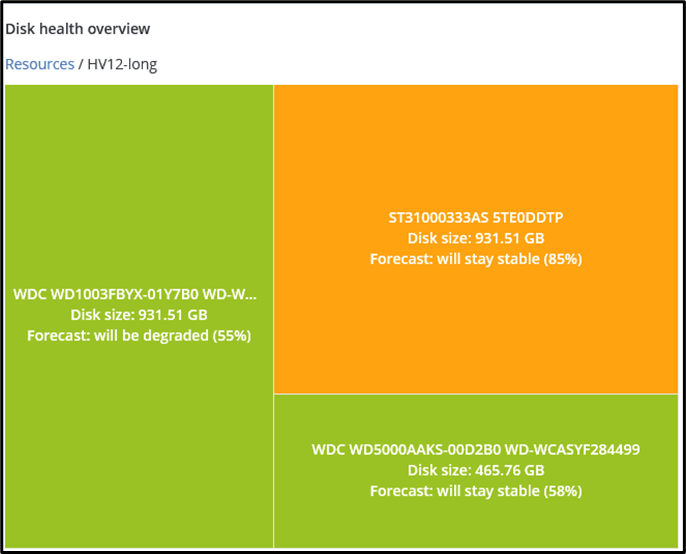
Drive Health Monitoring uses AI to analyze drive behavior and predict imminent failures before they happen, giving administrators time to migrate data. Remote Desktop provides RDP and a proprietary NEAR protocol for troubleshooting, with session recording for audit trails.
Source: Acronis
Where Acronis Falls Short
While Acronis excels at consolidating endpoint protection and backup into a single agent, several limitations become apparent for MSPs evaluating the platform for their client base.
Overcomplicated Dashboard and Policy Engine: MSPs managing large portfolios frequently report that Acronis's console can slow teams down.
The sheer breadth of options across backup, security, and management creates a steep learning curve. Configuration complexity increases significantly when multiple Advanced Packs are enabled, requiring substantial training overhead before technicians can efficiently manage client environments.
Resource-Heavy Agent: User feedback consistently highlights that the Acronis agent can impact endpoint and server performance, particularly on older hardware or resource-constrained systems. The comprehensive "do-it-all" approach means the agent handles backup, antivirus, vulnerability scanning, and more simultaneously, which some users report creates noticeable performance degradation.
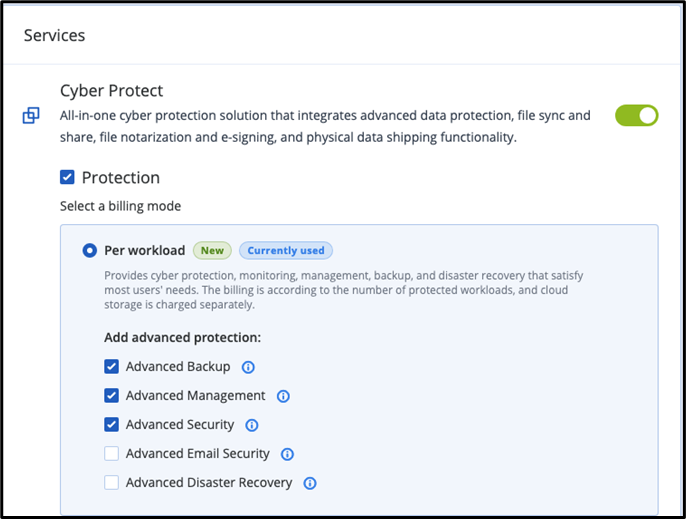
Fragmented Modular Pricing: Acronis separates its capabilities into a base Protection tier and multiple Advanced Packs (Advanced Backup, Advanced Security, Advanced Disaster Recovery, Advanced Email Security, Advanced Security Awareness Training, and more). This à la carte model means pricing can balloon unpredictably as MSPs add capabilities their clients need. What appears to be competitive base pricing often escalates significantly once essential modules are included.
Source: Acronis
Third-Party Powered Security Modules: Acronis offers email security and security awareness training as Advanced Packs, but these are powered by third-party technology (Perception Point for email security, Wizer and Infima for training). For MSPs who prefer purpose-built, natively developed tools with deeper integration and a unified development roadmap, this approach may feel disjointed rather than cohesive.
Support Inconsistency: User reviews frequently mention variable customer support experiences. While some report excellent assistance, others describe slow response times and unhelpful tier-1 support interactions. For MSPs who value a direct vendor relationship and the ability to reach someone who knows their account, this can be a significant concern.
URL Filtering vs DNS Filtering: Acronis includes URL filtering within its endpoint agent, but this differs from dedicated DNS-layer filtering solutions. DNS filtering blocks threats before connections are established and works across all applications and devices, while agent-based URL filtering is typically limited to browser traffic on devices where the agent is installed.
These considerations reflect different approaches to MSP security architecture. MSPs who prioritize a streamlined platform with purpose-built tools, simpler pricing, and stronger support relationships may find alternatives that better match their operational needs.
Top Acronis Alternative: CyberSentriq
CyberSentriq takes a fundamentally different approach: a unified, MSP-first platform that combines purpose-built security tools with cloud-native data protection under one vendor relationship.
Formed in June 2025 from the merger of TitanHQ and Redstor (backed by Bregal Milestone), the platform brings together nearly 30 years of email security expertise with modern cloud-native backup innovation, serving over 3,000 MSP partners and approximately 150,000 SMBs globally.
The philosophy centers on what CyberSentriq calls "MSP First": one contract, one support path, one roadmap, and one dedicated Account Manager. Rather than fragmenting capabilities across separately purchased modules, CyberSentriq provides an integrated platform where natively developed tools work together through defense-in-depth architecture.
Two-Layer Email Defense
CyberSentriq's email security implements a defense-in-depth strategy with protection at multiple layers, available through the CyberSentriq 360 E-Mail Security bundle.
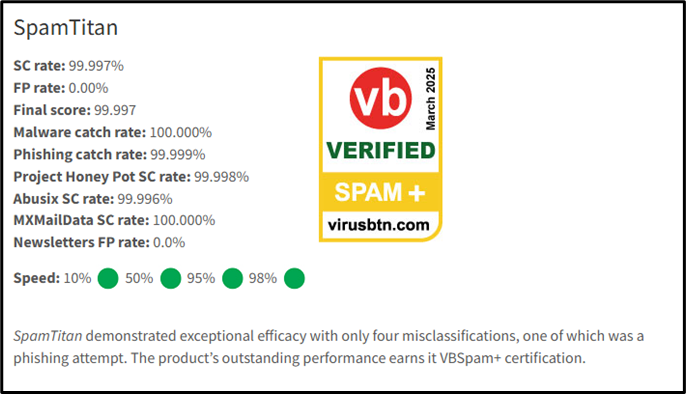
SpamTitan operates as a Secure Email Gateway (SEG) at the MX layer, stopping threats before they reach the Microsoft 365 environment. The gateway provides multi-layered filtering with a reported 99.99% spam catch rate, combining Real-time Blackhole Lists, sender authentication (SPF, DKIM, DMARC), greylisting, dual antivirus engines (Bitdefender and ClamAV), and sandboxing for suspicious attachments. With over 400 spam rulesets for precision scoring, it blocks commodity threats at the perimeter.
PhishTitan adds an Integrated Cloud Email Security (ICES) layer that sits inside the Microsoft 365 tenant via API.
This layer uses AI-driven analysis and large language model intent recognition to detect advanced attacks that bypass gateway filtering: business email compromise, C-level impersonation, and social engineering. Critically, it also monitors internal mail traffic that never passes through the gateway, providing time-of-click protection through Link Lock and enabling rapid post-delivery remediation.
This two-layer approach (MX on the outside, API on the inside) ensures threats are stopped at the gateway before reaching Microsoft, while advanced attacks that evade perimeter defenses are caught at the inbox level.
Behavior-Driven Security Awareness Training
SafeTitan provides security awareness training that intervenes in real-time based on actual user behavior.
Unlike scheduled training programs or third-party powered modules, SafeTitan delivers training at the moment users exhibit risky behavior. If someone clicks a link in a simulated phishing email, they receive relevant training immediately, when the learning opportunity is most impactful.
The platform includes over 1,800 phishing templates updated to reflect current threats, covering business email compromise, CEO fraud, and ransomware scenarios. MSPs can schedule automated campaigns for an entire year in minutes using the Auto Campaigns feature, reducing administrative overhead while maintaining continuous security awareness.
Training modules are designed as short, gamified content (8-10 minutes) to maintain engagement without impacting productivity. The platform supports compliance requirements for ISO, HIPAA, PCI, GDPR, and EU NIS, with detailed reporting that helps MSPs demonstrate training effectiveness during QBRs.
DNS-Layer Web Security
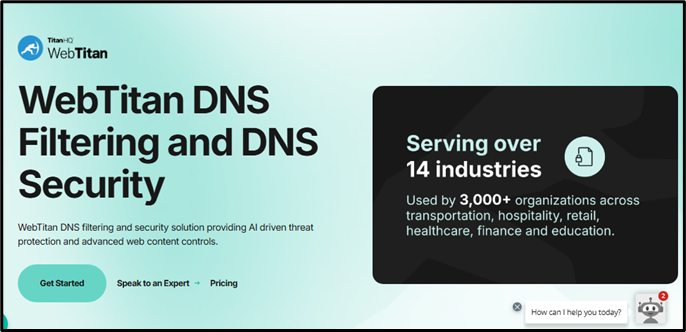
WebTitan operates at the DNS layer, processing over 2 billion DNS requests daily.
Source: TitanHQ
When a user or device attempts to access a website, the request routes through WebTitan's servers for policy and threat analysis before the connection is established. This approach blocks malicious sites before any content is downloaded, protecting all applications and devices on the network rather than just browser traffic on agent-installed endpoints.
The system enforces acceptable use policies and provides protection for remote users through the On-The-Go agent. For MSPs, this means consistent web security across office networks, remote workers, and BYOD devices without deploying heavy endpoint agents.
Cloud-Native Data Protection with InstantData™
CyberSentriq's data protection, built on Redstor's technology, is a cloud-native, appliance-free solution designed to eliminate on-prem hardware dependencies and the associated maintenance overhead.
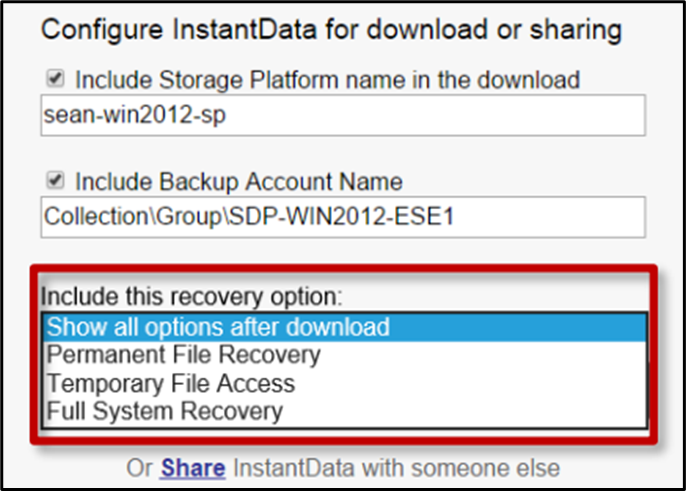
The platform's InstantData™ technology represents a fundamentally different approach to recovery. Rather than waiting for full dataset restoration before accessing files, InstantData™ streams requested data on demand. Users can open and work with files in seconds while full restoration continues in the background.
For system recovery, the technology can boot a VM from backup with data streaming as needed, reducing downtime during critical incidents.
Source: RedStor
The platform protects diverse environments from a single console: physical servers, virtual machines, endpoints, Azure and AWS workloads, and SaaS applications including Microsoft 365, Google Workspace, Salesforce, and notably Microsoft Entra ID (a differentiator from competitors that lack identity backup capabilities).
AI-powered malware detection scans backups for threats before recovery, ensuring restored data doesn't reintroduce ransomware or other malware. The machine learning model identifies malicious patterns and quarantines suspicious files with 99.35% detection accuracy.
Pricing follows a predictable model: per-gigabyte pricing with no egress fees for recovery and no surprise cost increases as data estates grow.
MSP-First Platform Design
CyberSentriq's platform is built specifically for MSPs with multi-tenancy at its core. The MSP Sentriq partner program provides each partner with a dedicated Account Manager as a single point of contact for all strategy, pricing, and commercial conversations.
This MSP-First approach extends to practical operations: deployment in under 30 minutes with clean UX and low management overhead, white-label capabilities allowing MSPs to position their own brand front and center, and tiered pricing models (Silver, Gold, Platinum, Top Tier) that enable MSPs to increase their margins as they grow.
Perhaps most distinctively, CyberSentriq emphasizes the personal relationship that partners often miss with larger vendors. The company's commitment to accessibility means someone actually picks up the phone when MSPs call for support, with named Account Managers who understand each partner's business rather than anonymous ticket queues.
Native integrations connect with major PSA and RMM tools including ConnectWise, Datto, and Kaseya. The partner program provides marketing resources, lead referrals, quarterly account reviews with data-driven insights, and early roadmap access.
Acronis or CyberSentriq: Comparison Summary
|
Aspect |
Acronis |
CyberSentriq |
|
Platform Architecture |
Single comprehensive endpoint agent |
Unified MSP platform with purpose-built tools |
|
Email Security |
⭐⭐⭐ Third-party powered add-on module |
⭐⭐⭐⭐⭐ Native two-layer defense (gateway + API) |
|
Web Filtering |
⭐⭐⭐ Agent-based URL filtering |
⭐⭐⭐⭐⭐ DNS-layer filtering (all devices/apps) |
|
Security Training |
⭐⭐⭐ Third-party powered add-on module |
⭐⭐⭐⭐⭐ Native behavior-driven with real-time intervention |
|
Endpoint Protection |
⭐⭐⭐⭐⭐ Active Protection, AV, anti-ransomware |
⭐⭐⭐ Via backup malware detection |
|
Backup/DR |
⭐⭐⭐⭐ Full image, CDP, Instant Restore |
⭐⭐⭐⭐⭐ InstantData™ streaming recovery |
|
Recovery Speed |
Fast (Instant Restore mounts VM) |
Near-instant (InstantData™ streams on-demand) |
|
Agent Footprint |
Resource-heavy comprehensive agent |
Lightweight, purpose-built components |
|
Console Complexity |
Complex dashboard with significant training overhead |
Streamlined UX, deploys in under 30 minutes |
|
SaaS Protection |
Microsoft 365, Google Workspace |
M365, Google Workspace, Salesforce, Entra ID |
|
MSP Support Model |
Standard support tiers |
Dedicated Account Manager per partner |
|
Pricing Model |
Base tier + multiple Advanced Pack modules |
Transparent bundles with tiered MSP pricing |
|
Security Heritage |
Backup-first, pivoted to security in 2018 |
Nearly 30 years of email security expertise |
Final Verdict
The choice between Acronis and CyberSentriq reflects different philosophies about how MSPs should deliver cyber protection to their clients.
Choose Acronis if your primary concern is endpoint-centric protection with a single comprehensive agent.
It's the right fit when you want backup and ransomware defense tightly coupled at the endpoint level and are willing to navigate the Advanced Pack pricing model to build out additional capabilities. Organizations facing primarily endpoint-based threats, with IT teams comfortable managing a feature-rich console, will find Acronis provides deep endpoint protection.
Just be prepared for the training investment required to master the platform and the potential for costs to increase as you add necessary modules.
Get started with Acronis here.
Choose CyberSentriq if you're an MSP seeking a streamlined, unified platform with purpose-built tools, simpler vendor relationships, and predictable pricing.
It's the better choice when you want native, in-house developed email security with defense-in-depth architecture rather than third-party powered add-ons, when behavior-driven security training with real-time intervention matters, and when near-instant streaming recovery could be the difference between hours and seconds of downtime during an incident.
MSPs who value having a dedicated Account Manager who knows their business, want white-label capabilities to strengthen their own brand, and prefer transparent pricing that doesn't balloon with each additional module will find CyberSentriq built specifically for how they operate.
Get started with CyberSentriq here.
The decision ultimately comes down to whether you prioritize a single endpoint agent or a unified MSP platform with purpose-built tools, and whether you prefer navigating modular add-ons or working with a vendor designed from the ground up for the MSP business model.
Ready to get started?
