
Veeam has become synonymous with enterprise data protection, serving over 450,000 customers worldwide and protecting data for 77% of the Fortune 500. With its comprehensive backup, replication, and disaster recovery capabilities, the platform has earned its reputation as a reliable solution for organizations that cannot afford data loss or extended downtime.
To create this Veeam review, I've analyzed the platform extensively. I believe it's the ideal choice if:
- You need comprehensive backup and disaster recovery across virtual, physical, and cloud environments
- You prioritize proven reliability and fast recovery times
- You already have separate security solutions for email, web, and endpoint protection
- You require deep integration with VMware, Hyper-V, and major cloud providers
- You have the technical resources to manage complex infrastructure and upgrade cycles
- You need enterprise-grade features with a large partner ecosystem
However, Veeam might not be the best choice if:
- You're an MSP looking for a unified cybersecurity and data protection platform
- You want proactive security measures (email filtering, web security, security training) alongside backup
- You prefer simpler, more predictable pricing without complex licensing tiers
- You need to consolidate vendors and reduce management complexity
- You want to eliminate on-premises hardware dependencies
- Budget constraints make enterprise pricing challenging
In this case, you should consider CyberSentriq: a newly formed platform combining Redstor's cloud-native data protection with TitanHQ's cybersecurity suite. This integration creates a unified solution that addresses both reactive data protection and proactive threat prevention, all designed with Managed Service Providers in mind.
Because of that, I've included a detailed look at CyberSentriq later in this Veeam review, as an alternative for organizations seeking integrated cyber resilience rather than backup alone. If you're ready to explore a platform that combines data protection with proactive security, you can learn more about CyberSentriq here.
What is Veeam?
Veeam is a US-based data protection company founded in 2006 by Andrei Baronov and Ratmir Timashev, who previously sold their IT management company Aelita Software to Quest Software.
The founders recognized that virtualization was transforming enterprise IT, and traditional backup solutions weren't designed for virtual machine environments. Veeam was an early vendor to create backup software specifically tailored for VMs.
Today, Veeam has evolved into a comprehensive data protection platform serving cloud, virtual, physical, SaaS, and Kubernetes environments. The company was acquired by Insight Partners in 2020 for $5 billion and has since reached a valuation of $15 billion with approximately 6,000 employees.
Veeam's flagship product, Veeam Backup & Replication, forms the core of the Veeam Data Platform.
The company promotes "radical resilience" as its mission, enabling organizations to not only recover from data disruptions but to "bounce forward" with confidence. Key capabilities include image-based VM backup, instant recovery, replication for disaster recovery, and monitoring through Veeam ONE.
The platform's ideal users include enterprises with significant virtual infrastructure investments, organizations migrating workloads to public clouds, businesses using Microsoft 365 that need independent backup, and companies in regulated industries with strict data protection requirements.
Veeam Pros & Cons
|
Pros |
Cons |
|
✅ Strong reliability with SureBackup verification |
❌ Complex deployment and ongoing maintenance requirements |
|
✅ Comprehensive platform support (VMware, Hyper-V, Nutanix, AWS, Azure) |
❌ Heavy reliance on on-premises hardware and infrastructure |
|
✅ Instant VM Recovery reduces downtime to minutes |
❌ Microsoft 365 protection requires separate product and licensing |
|
✅ Extensive partner ecosystem with 70,000+ partners |
❌ Licensing becomes unpredictable and expensive as environments scale |
|
✅ 340+ preset alarms with Veeam ONE monitoring |
❌ Upgrade cycles can introduce downtime and operational risk |
|
✅ Strong ransomware recovery with immutable backups |
❌ Requires separate vendors for email security, web filtering |
|
✅ Entra ID backup capabilities available |
❌ Steep learning curve for advanced features and configuration |
Veeam Review: How it Works & Key Features
Backup and Replication: The Foundation of Veeam's Platform
Veeam Backup & Replication operates through a coordinated architecture: the Veeam Backup Server orchestrates all tasks, Backup Proxies process and transfer data, and Backup Repositories store the backup files. This modular approach allows for scalable deployments across environments of various sizes, though it does require significant infrastructure planning and ongoing management.
The backup process leverages image-based capture at the hypervisor level, taking a complete snapshot of the VM including virtual disks and configuration.
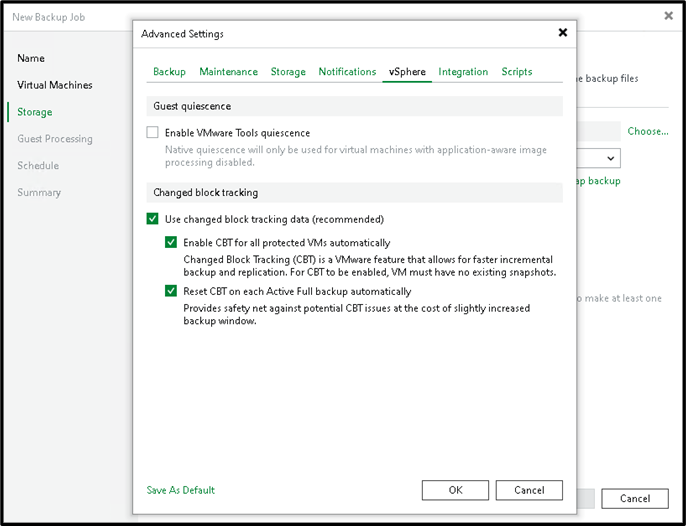
For efficiency, Veeam uses Changed Block Tracking (CBT) to identify and copy only modified data blocks after the initial full backup. Data undergoes compression and deduplication before transfer, reducing both storage consumption and network bandwidth requirements.
Source: Veeam
Veeam supports multiple hypervisors including VMware vSphere, Microsoft Hyper-V, and Nutanix AHV. This multi-platform support extends to physical servers through Veeam Agents for Windows, Linux, and macOS. Application-aware processing ensures transactional consistency for critical applications like Microsoft SQL Server, Exchange, and Oracle.
Replication creates and maintains ready-to-start copies of VMs on secondary hosts for disaster recovery. Unlike backups stored in compressed format, replicas exist in native hypervisor format and can be powered on almost immediately during a failover scenario.
Instant Recovery: Minimizing Downtime
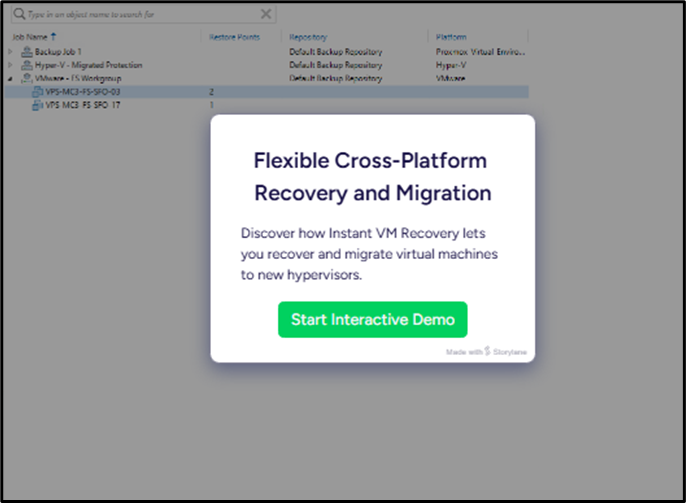
Veeam pioneered Instant VM Recovery technology, which allows failed VMs to be restarted directly from backup files within minutes rather than waiting for a full restore.
The process mounts the backup to an ESXi host via Veeam's vPower NFS Service, creating a functional VM that runs while the actual data migrates to production storage in the background.
Source: Veeam
Beyond full VM recovery, Veeam provides granular options through its Explorer tools. Veeam Explorer for Microsoft Exchange allows recovery of individual emails, calendars, and contacts. Similar explorers exist for SharePoint, Active Directory, SQL Server, and Oracle, enabling item-level recovery without restoring entire systems.
File-level recovery presents backed-up data through a file browser interface, allowing users to retrieve specific files from any supported guest operating system. This flexibility means administrators can address most recovery scenarios without consuming time on unnecessary full restores. However, it's worth noting that restore processes outside of the Instant VM Recovery scenario can become slower and more cumbersome, particularly for larger datasets or mixed hybrid environments.
Protecting Microsoft 365: A Separate Solution
Veeam Backup for Microsoft 365 protects Exchange Online, SharePoint Online, OneDrive for Business, and Microsoft Teams. The solution operates on the shared responsibility model principle, where Microsoft ensures infrastructure availability but customers remain responsible for their data protection.
The product captures complete copies of Microsoft 365 data, storing them in locations the customer controls, whether on-premises or in cloud storage. This independence from Microsoft's native retention provides protection against accidental deletion, security threats, and retention policy gaps that might leave data unrecoverable. Veeam also offers Entra ID backup capabilities for organizations needing to protect their identity infrastructure.
Source: Veeam
It's worth noting that Veeam Backup for Microsoft 365 is a separate product with its own licensing, distinct from the main Veeam Data Platform. Organizations protecting both on-premises infrastructure and Microsoft 365 need to budget for both.
Monitoring with Veeam ONE: Visibility into Your Backup Environment
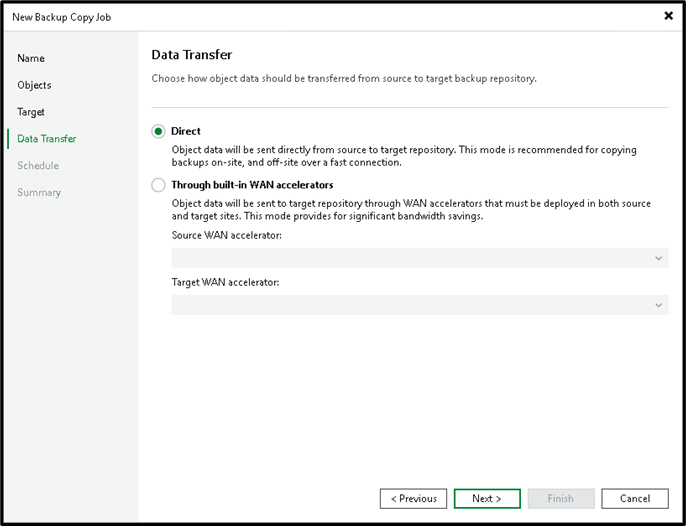
Veeam ONE provides monitoring, analytics, and reporting for both the backup infrastructure and the production environment. The platform offers real-time dashboards, over 340 preset alarms based on best practices, and more than 150 pre-built reports covering infrastructure performance, configuration assessments, and compliance.
The monitoring extends beyond backup success rates to include capacity planning, resource optimization, and identification of idle or oversized VMs. Alarms can automatically notify administrators of potential issues before they impact operations.
Veeam ONE is included in the Veeam Data Platform's Advanced and Premium editions, providing a unified view that connects backup status with the health of the systems being protected.
Source: Veeam
Where Veeam Falls Short
While Veeam excels at data protection, several limitations reveal a platform optimized primarily for backup and recovery rather than comprehensive cyber resilience.
Reactive-Focused Security Posture: Veeam includes ransomware recovery features like immutable backups and malware detection during restore, but these are largely reactive measures.
While recent versions have added inline scanning and threat hunting capabilities, the platform doesn't address how threats enter environments in the first place. Organizations still need separate solutions for email security, web filtering, and phishing protection, creating gaps between detection and protection.
Source: Veeam
Deployment and Maintenance Complexity: Veeam's enterprise-grade architecture requires significant expertise to deploy and maintain effectively.
The platform's reliance on on-premises infrastructure means organizations need to manage Backup Servers, Proxies, and Repositories, along with the underlying hardware. For MSPs managing multiple clients or lean IT teams, this complexity translates to higher operational overhead and specialist skill requirements.
Challenging Upgrade Cycles: Major version upgrades can introduce downtime and operational risk, requiring careful planning and testing. Organizations must coordinate upgrade windows, validate compatibility with existing infrastructure, and sometimes navigate breaking changes that affect established workflows.
Complexity for MSPs Managing Multiple Clients: While Veeam now offers a Service Provider Console, its core architecture evolved from enterprise-focused roots.
Managing numerous smaller clients across diverse environments can become administratively complex. The multi-tiered pricing structure (Foundation, Advanced, Premium) with various add-ons requires careful navigation to avoid unexpected costs as client environments grow.
Fragmented Product Portfolio: Microsoft 365 protection requires a separate product with its own licensing.
The Veeam Data Platform's three editions have different feature sets, and capabilities like Veeam Vault secure storage or incident response services come as additional add-ons. This modularity provides flexibility but also complexity in determining total cost of ownership and creates challenges for organizations wanting unified protection across hybrid and SaaS workloads.
No Proactive Security Layers: Veeam doesn't offer email spam filtering or DNS-based web protection. Organizations seeking these capabilities must integrate separate vendors, managing multiple dashboards, support relationships, and billing cycles.
These limitations aren't failures but reflect Veeam's strategic focus on being excellent at data protection for enterprises. However, they create clear opportunities for platforms that take a more integrated, simplified approach to cyber resilience, particularly for MSPs and SMBs who need modern, cloud-native solutions without the infrastructure overhead.
Top Veeam Alternative for Integrated Cyber Resilience: CyberSentriq
i
CyberSentriq emerged in June 2025 from the merger of two established companies: TitanHQ (founded 1999) and Redstor (founded 1998). Backed by Bregal Milestone, this combination creates an integrated cybersecurity and data protection platform serving over 3,000 MSP partners and approximately 150,000 SMBs globally.
The merger's logic is straightforward: modern cyber resilience requires both preventing threats and recovering from them. Rather than asking organizations to stitch together separate vendors, CyberSentriq provides both capabilities from a single platform built specifically for Managed Service Providers.
The company operates with an MSP First model, meaning one contract, one support path, one product roadmap, and one dedicated Account Manager for partners.
Data Protection with Cloud-Native Technology
CyberSentriq's data protection component provides cloud-native backup, recovery, and archiving without requiring on-premises hardware.
Source: CyberSentriq
The platform protects physical servers, virtual machines, endpoints, and SaaS applications including Microsoft 365, Google Workspace, and Salesforce from a single web-based console. Critically, the platform also offers Entra ID backup capabilities, providing protection for identity infrastructure that many backup solutions overlook.
A distinguishing capability is InstantData™, CyberSentriq's patented streaming technology that provides on-demand access to backed-up data. Rather than waiting for a full restore to complete, users can stream files immediately, accessing critical data while the complete recovery happens in the background. This approach reduces effective recovery time compared to traditional restore processes that can become slow or cumbersome during critical incidents.
Backups undergo AI-powered malware detection that scans for threats before recovery, preventing the reintroduction of ransomware or other malicious code into production environments. Suspicious files are automatically quarantined, ensuring clean restores.
Proactive Cybersecurity with Defense-in-Depth
CyberSentriq adds security layers that prevent threats from reaching organizations in the first place:
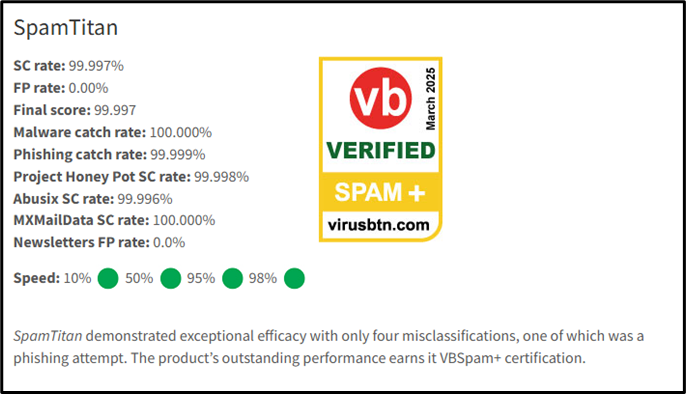
SpamTitan provides multi-layered email security with a 99.97% spam catch rate and dual antivirus engines (Bitdefender and ClamAV). The solution includes sandboxing for zero-day threats, DMARC/DKIM/SPF authentication, and outbound email scanning. As a gateway solution sitting outside the M365 environment, it stops threats before they ever reach Microsoft's infrastructure.
WebTitan offers DNS-based web filtering that blocks access to malicious websites and inappropriate content before connections are established. The AI-powered threat intelligence database controls access to over 3 million malicious websites at any given time.
SafeTitan delivers security awareness training with simulated phishing campaigns. When users engage with simulated threats, they receive immediate, contextual training rather than generic annual compliance sessions. The behavior-driven approach has been shown to reduce staff susceptibility to phishing by up to 92%.
PhishTitan provides dedicated anti-phishing protection with AI and LLM-driven analysis, auto-remediation, and URL rewriting for Microsoft 365 environments. As an API-based solution sitting inside M365, it complements the gateway protection to create true defense-in-depth.
MSP-First Platform Design
CyberSentriq's architecture reflects its explicit focus on the MSP and SMB market rather than enterprise customers. The multi-tenant platform allows providers to manage all clients from a single dashboard without multiple logins, and can be deployed in under 30 minutes with minimal management overhead.
Key features include:
- Centralized management across all clients and data sources with white-label capabilities
- Simple, predictable pricing without hidden egress fees or bandwidth charges
- Co-branded marketing materials and customer-facing portals
- 24/7 technical support for critical issues with dedicated MSP programs; partners consistently note that someone actually picks up the phone when they call
- Channel-focused sales model with a dedicated Account Manager for each partner
- Tiered pricing models that enable MSPs to increase margins as they grow
The unified approach means MSPs can deliver email security, web filtering, security training, backup, and disaster recovery as a cohesive service rather than managing separate vendor relationships for each capability. This consolidation addresses one of the biggest operational challenges for service providers: vendor sprawl.
Veeam or CyberSentriq: Comparison Summary
|
Aspect |
Veeam |
CyberSentriq |
|
Primary Focus |
Data protection and disaster recovery |
Integrated cybersecurity and data protection |
|
Target Audience |
Enterprises of all sizes |
MSPs and SMBs (not enterprise-focused) |
|
Data Protection |
⭐⭐⭐⭐⭐ Comprehensive, industry-leading |
⭐⭐⭐⭐ Cloud-native with InstantData™ streaming |
|
Email Security |
❌ Not included |
⭐⭐⭐⭐⭐ SpamTitan with 99.97% catch rate |
|
Web Filtering |
❌ Not included |
⭐⭐⭐⭐⭐ WebTitan DNS filtering |
|
Security Awareness Training |
❌ Not included |
⭐⭐⭐⭐⭐ SafeTitan with real-time intervention |
|
Microsoft 365 Backup |
⭐⭐⭐⭐⭐ Comprehensive (separate product) |
⭐⭐⭐⭐ Included in base platform |
|
Entra ID Backup |
✅ Available |
✅ Available |
|
Hypervisor Support |
VMware, Hyper-V, Nutanix AHV |
Hyper-V, VMware |
|
Hardware Requirements |
On-premises infrastructure required |
Cloud-native, appliance-free |
|
Deployment Complexity |
Complex, requires specialist skills |
Under 30 minutes, minimal overhead |
|
Pricing Model |
Tiered editions with add-ons, can be unpredictable |
Simple per-user pricing, predictable |
|
MSP Multi-Tenancy |
Supported (enterprise roots) |
Purpose-built for MSPs |
|
Best For |
Enterprises needing pure data protection |
MSPs wanting unified security + backup |
Final Verdict
The choice between Veeam and CyberSentriq depends on whether you need focused enterprise data protection or integrated cyber resilience designed for the MSP/SMB market.
Choose Veeam if your primary concern is reliable backup and disaster recovery across complex enterprise environments and you have the technical resources to manage the infrastructure.
Veeam's nearly two decades of focus on data protection have produced mature capabilities that serve organizations with extensive VMware infrastructure, stringent recovery requirements, and existing security tooling. If you already have email security, web filtering, and security training from other vendors, have staff skilled in managing on-premises backup infrastructure, and simply need the best dedicated backup solution available, Veeam delivers proven reliability backed by a massive partner ecosystem.
Choose CyberSentriq if you're an MSP or SMB seeking to consolidate your security and data protection under one platform without the complexity of enterprise infrastructure.
The combination of cloud-native backup with InstantData™ streaming recovery and TitanHQ's proactive security layers creates a unified approach to cyber resilience that addresses both preventing attacks and recovering from them. For service providers managing multiple clients, the MSP First architecture, with its dedicated Account Manager, simple pricing, white-label capabilities, and responsive support, makes delivering comprehensive protection operationally efficient.
The platform's explicit focus on the MSP and SMB market means you're not paying for or navigating enterprise complexity you don't need.
Get started with CyberSentriq here.
Both platforms serve their audiences well. Veeam represents the best of dedicated enterprise data protection for organizations with the resources to manage it; CyberSentriq represents the integration of protection and prevention into a single, simplified operational relationship designed specifically for MSPs and SMBs.
Your choice depends on whether backup is a standalone requirement in an enterprise context or part of a broader cyber resilience strategy for the service provider market.
Ready to get started?
